

X


VR Simulation project
VR Simulation project
VR Simulation project
What is the project?
Robotic surgery begins with mastering the basics and, increasingly, that training happens in virtual reality. VR simulation offers a reproducible, tissue-free way to build core robotic skills, without the cost and ethical weight of animal-tissue models. But a training curriculum is only as strong as the evidence behind it: which exercises truly build the right skills, and what score actually means a trainee is ready?
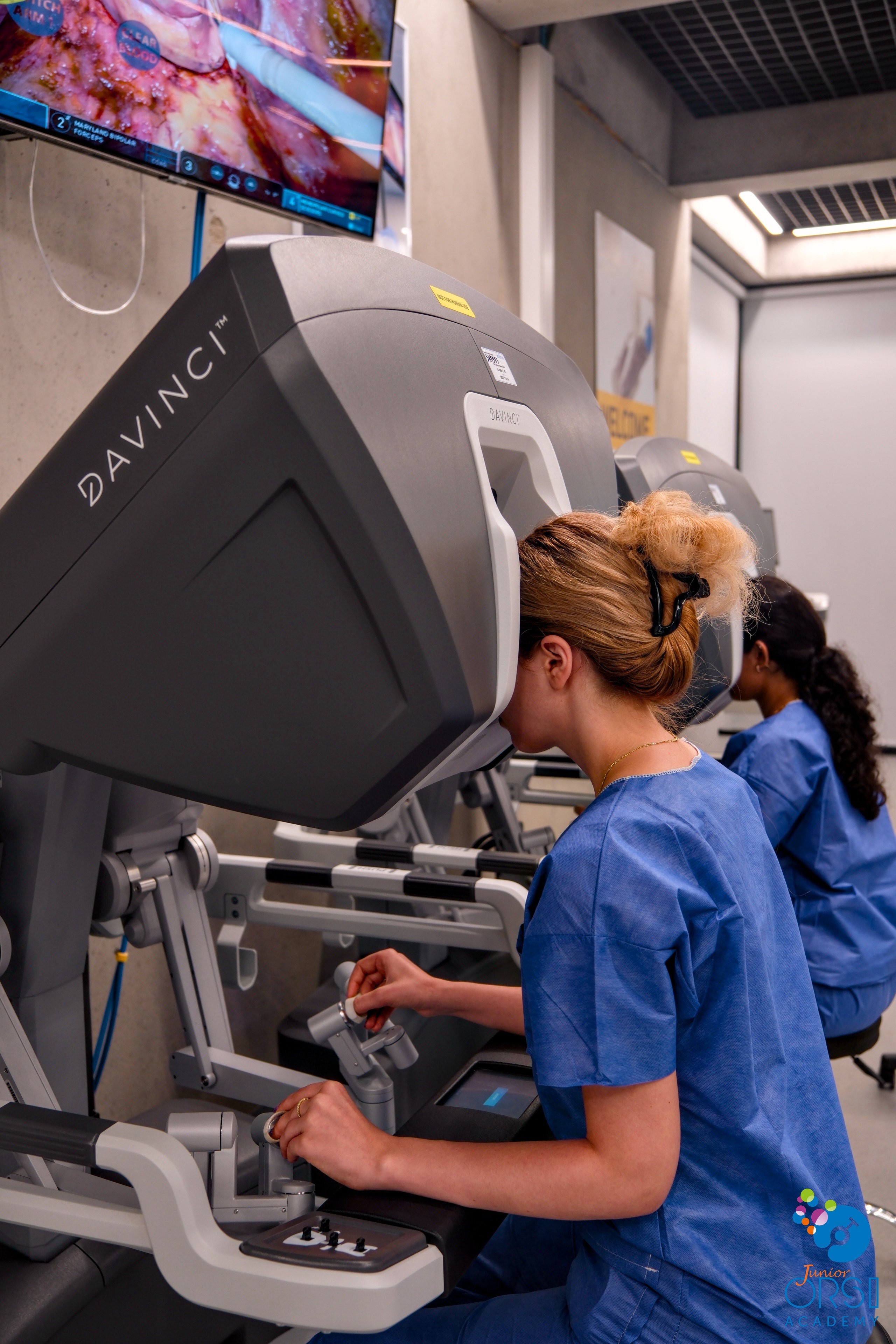
That's the question Orsi Academy wants to answer, and where you come in. Working on the da Vinci SimNow 2 simulator, you'll help develop and validate a VR module for Orsi's Basic Surgical Skills (BSS) training pathway. The core challenge: figure out which SimNow 2 exercises best represent the skills Orsi teaches, and whether their scores can reliably differentiate an expert from a novice and support proficiency-based progression.
Over the year you'll move from theory to real data: reviewing the literature on VR robotic-skills training and validation, mapping exercises to concrete learning objectives, helping design the validation protocol, and then collecting and analysing performance data from experts and novices on the simulator. The goal is an evidence-based module Orsi can fold into its own training, plus clear benchmarks for when a skill is genuinely mastered.
And you won't do it alone. You'll work in a hybrid setup: on-site at Orsi for simulator sessions and data collection, remotely for review and analysis, guided by your mentors and by Orsi's robotic- surgery faculty and fellows. The ambition is impact on two fronts: a training module that becomes part of how surgeons learn at Europe's largest robotic-surgery centre, and a genuine scientific output.
What is the project?
Robotic surgery begins with mastering the basics and, increasingly, that training happens in virtual reality. VR simulation offers a reproducible, tissue-free way to build core robotic skills, without the cost and ethical weight of animal-tissue models. But a training curriculum is only as strong as the evidence behind it: which exercises truly build the right skills, and what score actually means a trainee is ready?
That's the question Orsi Academy wants to answer, and where you come in. Working on the da Vinci SimNow 2 simulator, you'll help develop and validate a VR module for Orsi's Basic Surgical Skills (BSS) training pathway. The core challenge: figure out which SimNow 2 exercises best represent the skills Orsi teaches, and whether their scores can reliably differentiate an expert from a novice and support proficiency-based progression.
Over the year you'll move from theory to real data: reviewing the literature on VR robotic-skills training and validation, mapping exercises to concrete learning objectives, helping design the validation protocol, and then collecting and analysing performance data from experts and novices on the simulator. The goal is an evidence-based module Orsi can fold into its own training, plus clear benchmarks for when a skill is genuinely mastered.
And you won't do it alone. You'll work in a hybrid setup: on-site at Orsi for simulator sessions and data collection, remotely for review and analysis, guided by your mentors and by Orsi's robotic- surgery faculty and fellows. The ambition is impact on two fronts: a training module that becomes part of how surgeons learn at Europe's largest robotic-surgery centre, and a genuine scientific output.

In this project, you will:
Develop a VR training module
Help build and validate a simulation-based module for robotic-surgery training.Identify key simulator exercises
Determine which SimNow 2 exercises best represent Orsi’s Basic Surgical Skills.Analyse performance data
Compare expert and novice performance to define meaningful benchmarks.Work with experts
Collaborate with robotic-surgery faculty, fellows and research mentors at Orsi Academy.Create a publishable output
Contribute to a project with real impact on training and scientific research.
In this project, you will:
Develop a VR training module
Help build and validate a simulation-based module for robotic-surgery training.Identify key simulator exercises
Determine which SimNow 2 exercises best represent Orsi’s Basic Surgical Skills.Analyse performance data
Compare expert and novice performance to define meaningful benchmarks.Work with experts
Collaborate with robotic-surgery faculty, fellows and research mentors at Orsi Academy.Create a publishable output
Contribute to a project with real impact on training and scientific research.
In this project, you will:
Develop a VR training module
Help build and validate a simulation-based module for robotic-surgery training.Identify key simulator exercises
Determine which SimNow 2 exercises best represent Orsi’s Basic Surgical Skills.Analyse performance data
Compare expert and novice performance to define meaningful benchmarks.Work with experts
Collaborate with robotic-surgery faculty, fellows and research mentors at Orsi Academy.Create a publishable output
Contribute to a project with real impact on training and scientific research.
What is Orsi Education?
Orsi Education is a small, dedicated branch of Orsi Academy, focused specifically on the training and education of surgical residents, fellows and surgeons: helping the next generation build and refine their skills in robotic and minimally invasive surgery. It’s the team behind this project.
Orsi Academy, based in Melle, is Europe's largest centre of excellence for robotic and minimally invasive surgery. Founded in 2010 as a spin-off of the OLV Hospital in Aalst, it has grown into a globally renowned training and innovation hub where hundreds of surgeons and surgical teams from across the globe come to train every year.
Orsi is built as an open, collaborative ecosystem for co-creation and open innovation, working alongside leading medical societies, universities and med-tech partners. It's led by Prof. Dr. Alexandre Mottrie, a world-renowned urologist and pioneer of robotic surgery. For participants in the Research Program, Orsi is the environment where surgical innovation becomes real.
What is Orsi Education?
Orsi Education is a small, dedicated branch of Orsi Academy, focused specifically on the training and education of surgical residents, fellows and surgeons: helping the next generation build and refine their skills in robotic and minimally invasive surgery. It’s the team behind this project.
Orsi Academy, based in Melle, is Europe's largest centre of excellence for robotic and minimally invasive surgery. Founded in 2010 as a spin-off of the OLV Hospital in Aalst, it has grown into a globally renowned training and innovation hub where hundreds of surgeons and surgical teams from across the globe come to train every year.
Orsi is built as an open, collaborative ecosystem for co-creation and open innovation, working alongside leading medical societies, universities and med-tech partners. It's led by Prof. Dr. Alexandre Mottrie, a world renowned urologist and pioneer of robotic surgery. For participants in the Research Program, Orsi is the environment where surgical innovation becomes real.
What is Orsi Education?
Orsi Education is a small, dedicated branch of Orsi Academy, focused specifically on the training and education of surgical residents, fellows and surgeons: helping the next generation build and refine their skills in robotic and minimally invasive surgery. It’s the team behind this project.
Orsi Academy, based in Melle, is Europe's largest centre of excellence for robotic and minimally invasive surgery. Founded in 2010 as a spin-off of the OLV Hospital in Aalst, it has grown into a globally renowned training and innovation hub where hundreds of surgeons and surgical teams from across the globe come to train every year.
Orsi is built as an open, collaborative ecosystem for co-creation and open innovation, working alongside leading medical societies, universities and med-tech partners. It's led by Prof. Dr. Alexandre Mottrie, a world-renowned urologist and pioneer of robotic surgery. For participants in the Research Program, Orsi is the environment where surgical innovation becomes real.


Who are the mentors?
Prof. Dr. Niki Rashidian
Prof. Dr. Niki Rashidian is Director of Research and Skill Development at Orsi Academy, Hepatobiliary and Pancreatic Surgeon at Ghent University Hospital, and Professor of Innovative Computer-Assisted Surgery at Ghent University. Her clinical and research activities are centered around robotic surgery, surgical education, and the development and evaluation of innovative technologies that can enhance surgical training and patient care.
She holds a PhD in Proficiency-Based Progression (PBP) training and has a particular interest in structured curricula, objective performance assessment, faculty development, and technology- enhanced robotic surgery education. At Orsi Academy, she leads the development and implementation of evidence-based training pathways and explores how innovations such as surgical data science, artificial intelligence, simulation, and digital assessment tools can be integrated into training, with the goal of ensuring that trainees demonstrate proficiency before progressing to operate on patients.
Dr. Lennert Snijkers
Lennert Snijkers is a fifth-year resident in General Surgery and a PhD student in the education team at Orsi Academy, where his research focuses on Proficiency-Based Progression training for robot- assisted visceral surgery. His goal is to create an environment where the next generation of surgeons can develop their skills safely and efficiently.
Who are the mentors?
Prof. Dr. Niki Rashidian
Prof. Dr. Niki Rashidian is Director of Research and Skill Development at Orsi Academy, Hepatobiliary and Pancreatic Surgeon at Ghent University Hospital, and Professor of Innovative Computer-Assisted Surgery at Ghent University. Her clinical and research activities are centered around robotic surgery, surgical education, and the development and evaluation of innovative technologies that can enhance surgical training and patient care.
She holds a PhD in Proficiency-Based Progression (PBP) training and has a particular interest in structured curricula, objective performance assessment, faculty development, and technology- enhanced robotic surgery education. At Orsi Academy, she leads the development and implementation of evidence-based training pathways and explores how innovations such as surgical data science, artificial intelligence, simulation, and digital assessment tools can be integrated into training, with the goal of ensuring that trainees demonstrate proficiency before progressing to operate on patients.
Dr. Lennert Snijkers
Lennert Snijkers is a fifth-year resident in General Surgery and a PhD student in the education team at Orsi Academy, where his research focuses on Proficiency-Based Progression training for robot- assisted visceral surgery. His goal is to create an environment where the next generation of surgeons can develop their skills safely and efficiently.
Dr. Lennert Snijkers
Lennert Snijkers is a fifth-year resident in General Surgery and a PhD student in the education team at Orsi Academy, where his research focuses on Proficiency-Based Progression training for robot- assisted visceral surgery. His goal is to create an environment where the next generation of surgeons can develop their skills safely and efficiently.
Who are the mentors?
Prof. Dr. Niki Rashidian
Prof. Dr. Niki Rashidian is Director of Research and Skill Development at Orsi Academy, Hepatobiliary and Pancreatic Surgeon at Ghent University Hospital, and Professor of Innovative Computer-Assisted
Surgery at Ghent University. Her clinical and research activities are centered around robotic surgery, surgical education, and the development and evaluation of innovative technologies that can enhance surgical training and patient care.
She holds a PhD in Proficiency-Based Progression (PBP) training and has a particular interest in structured curricula, objective performance assessment, faculty development, and technology- enhanced robotic surgery education. At Orsi Academy, she leads the development and
implementation of evidence-based training pathways and explores how innovations such as surgical data science, artificial intelligence, simulation, and digital assessment tools can be integrated into training, with the goal of ensuring that trainees demonstrate proficiency before progressing to operate on patients.
Dr. Lennert Snijkers
Lennert Snijkers is a fifth-year resident in General Surgery and a PhD student in the education team at Orsi Academy, where his research focuses on Proficiency-Based Progression training for robot- assisted visceral surgery. His goal is to create an environment where the next generation of surgeons can develop their skills safely and efficiently.
Who are the mentors?
Could this be you?
We are looking for:
Motivated, reliable students, ready to commit for the full academic year.
Students in at least their second bachelor year, preferably with a background in medicine or biomedical engineering, though other biomedical backgrounds are very welcome too.
Students interested in surgical education, simulation and how we actually measure surgical skill.
students who enjoy research: reading the literature, designing a study, and working with data and basic statistics, or are eager to learn.
Students happy to mix hands-on simulator sessions on-site at Orsi with analytical work they can do remotely.
Team players who enjoy collaborating closely with surgeons, researchers and engineers.
No prior simulation or research experience required! You'll be trained and supported by your mentors and Orsi's robotic-surgery faculty.
Could this be you?
We are looking for:
Motivated, reliable students, ready to commit for the full academic year.
Students in at least their second bachelor year, preferably with a background in medicine or biomedical engineering, though other biomedical backgrounds are very welcome too.
Students interested in surgical education, simulation and how we actually measure surgical skill.
Students who enjoy research: reading the literature, designing a study, and working with data and basic statistics, or are eager to learn.
Students happy to mix hands-on simulator sessions on-site at Orsi with analytical work they can do remotely.
Team players who enjoy collaborating closely with surgeons, researchers and engineers.
No prior simulation or research experience required! You'll be trained and supported by your mentors and Orsi's robotic-surgery faculty.
Could this be you?
We are looking for:
Motivated, reliable students, ready to commit for the full academic year.
Students in at least their second bachelor year, preferably with a background in medicine or biomedical engineering, though other biomedical backgrounds are very welcome too.
Students interested in surgical education, simulation and how we actually measure surgical skill.
Students who enjoy research: reading the literature, designing a study, and working with data and basic statistics, or are eager to learn.
Students happy to mix hands-on simulator sessions on-site at Orsi with analytical work they can do remotely.
Team players who enjoy collaborating closely with surgeons, researchers and engineers.
No prior simulation or research experience required! You'll be trained and supported by your mentors and Orsi's robotic-surgery faculty.
Apply now ->
applications close: 11/10/2026 at 23h59
Only two students will join this project, will one of them be you?
Applications open at the start of the academic year. When you're ready, submit your CV and a short motivation through our application form.
Apply now ->
applications close: 11/10/2026 at 23h59
Only two students will join this project,
will one of them be you?
Applications open at the start of the academic year. When you're ready, submit your CV and a short motivation through our application form.
Apply now ->
applications close: 11/10/2026 at 23h59
Only two students will join this project, will one of them be you?
Applications open at the start of the academic year. When you're ready, submit your CV and a short motivation through our application form.